
Why Conventional Vitamin C Has Limited Absorption And How Advanced Delivery Systems Are Changing the Game
Vitamin C is one of the most recognized and widely used nutrients in the world — valued for immune support, antioxidant protection, collagen synthesis, and overall wellness. Yet, despite its popularity, one important fact is often overlooked:
Not all vitamin C consumed is actually absorbed and utilized efficiently by the body.
This raises an important question — if vitamin C is so essential, why do conventional forms often face absorption limitations?
The Challenge with Conventional Vitamin C
Traditional vitamin C, commonly available as ascorbic acid, is a water-soluble vitamin, which means the body does not store large amounts of it. Whatever is not absorbed or used is typically excreted.
While that may sound simple, absorption itself presents several challenges.
1. Saturable Absorption Mechanism
Vitamin C is absorbed in the intestines through specialized transporters. However, these transport systems have a limit.
At lower doses, absorption efficiency may be relatively high, but as dosage increases, the percentage absorbed can decrease significantly. In simple terms:
More vitamin C consumed does not necessarily mean more vitamin C delivered into cells.
This is one reason simply increasing dosage may not always improve effectiveness.
2. Losses During Digestion
Before vitamin C reaches circulation, it has to survive the digestive journey.
Factors such as:
- Gastric acidity
- Oxidative degradation
- Interactions within the gut environment
- Rapid transit and elimination
can all reduce the amount available for absorption.
For sensitive actives like vitamin C, delivery becomes just as important as dosage.
3. Short Circulation Time
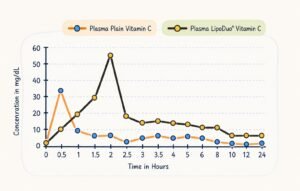
Conventional vitamin C can be rapidly absorbed and just as rapidly cleared.
This may result in:
- Brief spikes in plasma levels
- Limited sustained availability
- Reduced opportunity for prolonged cellular uptake
Which is why retention can be as important as absorption itself.
Why Bioavailability Matters More Than Dose
When evaluating efficacy, bioavailability — the proportion of a nutrient that reaches systemic circulation and becomes available for use — often matters more than the label claim.
A higher dose with poor delivery may underperform compared to a well-designed formulation with optimized absorption.
This is why advanced nutraceutical development increasingly focuses not only on what is delivered, but how it is delivered.
Advanced Delivery Approaches: The Role of Liposomal Technology
This is where lipid-based delivery systems have gained significant attention.
Liposomal technologies are designed to encapsulate active ingredients within phospholipid structures, helping:
- Protect sensitive actives from degradation
- Improve dispersion and transport
- Support enhanced uptake
- Potentially improve retention and utilization
For vitamin C, this can help address some of the inherent challenges associated with conventional delivery.
Where LipoDuo® Vitamin C Fits In
At Samarth Biorigins, LipoDuo® Vitamin C was developed with this delivery-first approach in mind.
Rather than focusing only on vitamin C content, the formulation is designed around bioavailability optimization, combining advanced liposomal delivery principles with controlled particle engineering to support improved performance.
The emphasis is not simply on delivering vitamin C — but on helping more of it reach where it can be effectively utilized.
That distinction matters.
Because in modern nutraceutical science, efficacy is increasingly linked to delivery technology, not dosage alone.
The Future of Vitamin C Is Smarter Delivery
As formulation science evolves, the conversation around vitamin C is shifting:
- From high dose to high efficiency
- From ingredient quantity to ingredient utilization
- And from conventional supplementation to advanced delivery solutions
Vitamin C remains foundational — but how it is delivered can make a meaningful difference.
Conclusion:
Conventional vitamin C has served the market for decades, but its absorption limitations have pushed innovation toward smarter systems.
Because ultimately, the goal isn’t simply to consume more vitamin C.
